2024 Impact Snapshot
The National Geographic Society is a global non-profit organization committed to illuminating and protecting the wonder of our world. In 2024, the Society continued its expansion of its Washington, D.C. headquarters, announced the National Geographic Museum of Exploration and funded Explorers across the globe who pushed the bounds of what is possible. This snapshot illustrates some of the ways that our Explorers have harnessed the powers of science, storytelling, education and exploration to share knowledge and inspire people across the globe to care for our world.
Thank you for supporting the National Geographic Society.
Home of the Explorer
The Society’s revitalized Base Camp, set to open in mid-2026, will be a historic expansion that transforms our campus into a global exploration hub and must-see destination that inspires the Explorer in everyone. With the addition of the National Geographic Museum of Exploration, Base Camp will become a convening space for collaboration, bringing together visionaries, learners and changemakers from around the world. We are incredibly grateful for the support of our Base Camp Founding Donors — including Cengage Group, Lyda Hill, Richard Terrance Kennedy and Heidi E. Morgan, Deborah M. Lehr and John F.W. Rogers, and Strive and Tsitsi Masiyiwa, who joined us in 2024 to help make this historic transformation possible.
2024 at a Glance
140+
374
active Explorer projects in 2024 spanned the Society’s six focus areas — Ocean, Land, Wildlife, Human Histories & Cultures, Planetary Health and Space.
$255.4K
6.9M
square kilometers of ocean have achieved protected status with support from Pristine Seas’ research and advocacy efforts.
54+
species new to science have been discovered through biodiversity surveys conducted by the Okavango Wilderness Project.
1,190
new species were photographed in 2024 for the National Geographic Photo Ark, bringing the total documented species to over 16,000.
100,490
live engagements with students through Explorer Classroom sessions in 2024 enriched learning experiences for the next generation of planetary stewards.
625
4.7M
people experienced one of National Geographic’s 18 traveling exhibitions in 2024, hosted in 20 countries around the world.
Photos (from left to right, top to bottom): National Geographic Young Explorer Brigitta Gunawan diving off the shore of Tulamben, Bali, Indonesia; Explorer and ecologist Isla Myers-Smith examines tundra plants in Yukon, Canada; a pair of cave divers prepare to enter Devil’s Ear, a limestone rift in Florida’s Santa Fe River; the vibrant Nautilus Reef in Papua New Guinea; a dragonfly is photographed in Angola; an ʻAnianiau at the Maui Bird Conservation Center in Makawao, HI, USA; Grosvenor Teacher Fellow Sandy Reed and students participate in a school district-wide Bioblitz in suburban Ohio; paleontologist and National Geographic Explorer Diego Pol analyzes the vertebrae of Carnotaurus, an abelisaurid theropod dinosaur from Patagonia; visitors enjoy the National Geographic gallery of the Root for Nature immersive exhibition at Palais des congrès in Montreal, Canada.
Impact in the Field
Ocean
Explorer Laurent Ballesta’s “Mystery of the Rings” project sheds light on the enigmatic Cape Corsica Rings — 1,417 unique coral formations shaped by 21,000 years of environmental shifts. His work is driving efforts to expand marine protections for this fragile ecosystem, with a stunning documentary set for global release in 2025.
Project CETI, led by Explorers David Gruber, Shane Gero and Robert Wood, made groundbreaking progress to create a “phonetic alphabet” used in sperm whale communication. By analyzing nearly 9,000 click sequences, researchers identified 156 distinct patterns, a crucial step toward deciphering how these intelligent creatures share information. Their work, amplified by cutting-edge AI and deep-sea cameras, was featured in Nature Communications and National Geographic magazine.
Explorer Agustina “Tati” Besada’s Unplastify program engaged communities worldwide to reduce single-use plastics. Through hands-on workshops, digital campaigns, and grassroots activism, Unplastify informed and inspired students and policymakers alike, leading to real-world impacts such as the adoption of biodegradable materials at one school in Chile and city-wide plastic reduction initiatives spearheaded by a school group in Ukraine.
These achievements, made possible by the generosity of donors and partners, are shaping a healthier future for our oceans and the life they sustain. Learn more about our Ocean programs.
Land
The Explorer-led World Freshwater Initiative advanced solutions for water shortages, identifying 21 global hotspots and supporting conservation projects in Chile, Japan, Türkiye, and Indonesia. New enhancements to the Society’s World Water Map — an innovative geovisualization resource that is central to the Initiative’s work — have helped advance global understanding about water scarcity.
Through his work to transform Rwanda’s Rugezi Marsh into a conservation area, Explorer Olivier Nsengimana’s efforts to protect this important habitat have contributed to a new record-high population of 1,293 endangered grey crowned cranes in 2024. Local stewardship of the program expanded through the training of 75 rangers, while biodiversity surveys cataloged 438 species, reinforcing the marsh’s ecological significance.
Explorer Diego Pol and his team doubled Patagonia’s fossil records in the Paleobiology Database and identified two new dinosaur species — Koleken inakayali, a short-armed carnivore, and Titanomachya gimenezi, a small titanosaur. Their discoveries are reshaping scientific understanding of Late Cretaceous biodiversity.
Through science, storytelling and education, these programs are shaping a more resilient future for our lands and the life they sustain. The National Geographic Society is grateful for the generous support of donors and partners who make this vital work possible. Learn more about our Land programs.
Wildlife
Explorer Joel Sartore‘s Photo Ark expanded its collection to more than 16,000 documented species, adding 1,190 new photographs in 2024, including the critically endangered Santa Cruz long-toed salamander. The impact of the Photo Ark project and Sartore’s work was further recognized through the naming of a newly discovered beetle species — Bothynus sartorei — in his honor.
In partnership with the Templeton World Charity Foundation, the Society’s Wildlife Intelligence Project supported three Explorers’ research into animal cognition. Mauricio Cantor studied cooperative behaviors between humans and dolphins, Tiago Falótico examined tool use in capuchin monkeys, and Felicity Muth explored bee decision-making, revealing new insights into animal intelligence.
Through his innovative WonderLab, Anand Varma blended science and photography to illuminate hidden natural phenomena. The project reached global audiences through an episode in the National Geographic Photographer documentary series, and provided mentorship to emerging science storytellers.
Through the support of donors and partners, projects like these are reaching communities and learners, helping shape the future of wildlife conservation worldwide. Learn more about our Wildlife programs.
Human Histories & Cultures
Explorer Paul Salopek continued his mission to trace human history by covering 4,020 miles across China and South Korea as part of his Out of Eden Walk project. With the help of numerous walking partners, he produced 44 text stories, 13 multimedia dispatches and nearly 19,000 images and videos throughout the year, sharing stories from people and communities that are often overlooked by global media.
Led by Explorer Victoria Herrmann, the Preserving Legacies project expanded to 12 new sites spanning 13 countries in 2024, and trained 30 local leaders in climate adaptation planning and strategies. On the ground, the program worked to support restoration efforts for the water management system at Petra in Jordan, and helped local partners at the Ifugao Rice Terraces in the Philippines integrate important traditional knowledge into climate policy.
In South Africa’s Cradle of Humankind, Explorer in Residence Lee Berger and team continued groundbreaking paleoanthropological work to redefine humanity’s origins. Excavations at Malapa and the Rising Star cave system yielded new insights into Homo naledi, including potential evidence of the hominid species’ use of hearths and tools.
2892 Miles to Go is a place-based education and storytelling program led by Explorer Ashley Lamb Sinclair. In 2024, the program engaged more than 600 youth and 130 educators across the United States, fostering a deeper understanding of the past to inspire action for a better future. The program also embraced innovative collaborations with Explorers including Alicia Odewale, Kristi Williams, and Brittney Beck, as well as partnering with the National Geographic Photo Camp program in Colorado.
Thanks to the support of donors and partners, these programs are helping to illuminate and preserve cultural and natural history, while working to shape a more harmonious future for our world. Learn more about our Human Histories and Cultures programs.
Planetary Health
Explorer Davide Monteleone’s Critical Minerals photojournalism project examines the environmental and geopolitical complexities of resource extraction for renewable technologies. Published in 2024, his interactive StoryMap traced the journey of minterals like cobalt and lithium from extraction to global markets, sparking critical discussions about sustainability in the pursuit of renewable energy.
Explorer Gladys Kalema-Zikusoka expanded her ingenious Model Households program, reaching thousands of families near Uganda’s Bwindi Impenetrable National Park in 2024. By improving hygiene, sanitation and agricultural practices, the initiative aims to reduce disease transmission between humans, livestock and endangered mountain gorillas, leading to a healthier coexistence and supporting the program’s goal to achieve a 30% total reduction in infectious diseases over the next few years.
Explorer Sonika Manandhar has worked to revolutionize Nepal’s public transit sector by providing financing for electric vehicle (EV) upgrades, particularly for women entrepreneurs operating Kathmandu’s Safa tempos. By ensuring long-term viability for these battery-powered three-wheelers, her efforts promote sustainable urban mobility while reducing emissions.
From deep forests to urban streets, these Explorer-led projects demonstrate how environmental solutions can improve both human and planetary health. The National Geographic Society is grateful for our generous community of supporters, who are helping advance this vital work. Learn more about our Planetary Health programs.
Space
Explorer Cody Paige led high-resolution 3D mapping of the Moon’s surface, testing scanning technologies in Spain’s volcanic landscapes and Antarctica’s polar conditions to simulate lunar exploration. These innovations will help scientists and astronauts navigate the Moon’s terrain more effectively.
Explorer Cynthia Chiang deployed the PRIZM instrument to remote locations like Marion Island to detect 21-centimeter hydrogen signals from the universe’s first billion years. Her work is shedding new light on the cosmic “dark ages,” a period before the first stars formed.
Explorer Moriba Jah launched the Glint Evader app, a tool designed to mitigate satellite light pollution for astronomers. His research, incorporating Indigenous knowledge, emphasizes sustainable space exploration and responsible stewardship of Earth’s orbital environment.
Explorer Martin Wikelski secured funding for the ICARUS satellite tracking system, which will launch in 2025 to monitor global animal migration. Data collected from six small satellites will enhance biodiversity protection, pandemic prediction and food security research.
With critical investment from our philanthropic supporters, the Society is advancing projects like these to broadening humanity’s understanding of the cosmos while working to ensure that the future of space exploration is responsible and sustainable. Learn more about our Space programs.
Perpetual Planet Expeditions
In 2024, National Geographic and Rolex Perpetual Planet Expeditions completed its landmark Amazon Expedition, chronicling the basin’s biodiversity through cutting-edge science, community engagement and storytelling work, and culminating with a single-topic National Geographic magazine issue and a documentary film on Hulu/Disney+. In a breakthrough study, Explorers used GPS-enabled collar cameras to track Andean bears, revealing never-before documented animal behaviors and transforming wildlife research. Looking ahead, Perpetual Planet Expeditions will shift focus to the ocean, beginning with a pioneering expedition in the Weddell Sea that launched in December 2024.
Pristine Seas
Pristine Seas, led by Explorer in Residence Enric Sala, continues to spearhead marine protection efforts worldwide. In 2024, the program played a pivotal role in the creation of a Marine Protected Area (MPA) around Isla de Lobos in Uruguay, ensuring the preservation of one of South America’s largest sea lion colonies. Additionally, the Azores established the largest MPA network in the North Atlantic—spanning 287,000 square kilometers—further advancing global ocean conservation goals.
Okavango Wilderness Project
The Okavango Wilderness Project, led by Explorer Steve Boyes, strengthened its impact in 2024 with the launch of Fundação Lisima in Angola — part of the Wild Bird Trust family of organizations — reinforcing collaborative conservation efforts in the region. Furthermore, the groundbreaking 2024 Lisima Biodiversity Survey revealed over 1,000 species of moths and 120 species of spiders — many new to science. The Project also made strides in research advocacy, presenting critical findings on the Angolan Highlands Water Tower to delegates at the Southern African Development Community Summit in August.
Behind the Yellow Border
Inspiring the Changemakers of Tomorrow
For nearly 40 years, the National Geographic Society’s education programs have connected students and educators with Explorers, igniting curiosity and inspiring action to protect the planet. In 2024, these initiatives engaged millions of learners worldwide through dynamic storytelling, hands-on experiences and innovative digital resources.
Photos: Students and educators participate in a school-district-wide Bioblitz for 5th graders; Photo Camp students capture photos on a game drive in a safari in Kissama National Park, Angola; Slingshot Challenge Youth Workshop during Earthshot Week in Cape Town, South Africa.
EduHub, the Society’s free online education platform, expanded its collection with 20 new Explorer-centered resources, covering topics such as environmental conservation and cultural heritage. The platform also integrated a globally inclusive learning design approach to ensure accessibility and cultural relevance for different learning communities.
Explorer Classroom brought the spirit of exploration into classrooms, engaging more than 100,000 students in live virtual events with 35 Explorers. Special series like the Ocean Expedition, co-developed with Pristine Seas and the Palau Ministry of Education, reached 40% of Palau’s student population, immersing learners in marine conservation efforts.
The Slingshot Challenge inspired young changemakers, receiving more than 2,100 submissions from 87 countries. Participants proposed bold solutions, from tree-planting robots to food waste reduction apps, demonstrating the next generation’s commitment to tackling environmental challenges.
Equipping Explorers to Go Further
The Exploration Technology Lab provided more than 600 Explorers with advanced tools, including a new marine Crittercam that provided new insights into the behavior of humpback whales and custom-built deep-sea cameras deployed to depths of 3,500 meters. The lab also supported key research, including Project CETI’s sperm whale studies in Dominica and Pristine Seas expeditions in Palau, Papua New Guinea and the Solomon Islands.
Impact Story Lab helps National Geographic Explorers harness the power of strategic storytelling to supercharge the impact of their work. The award-winning creative unit collaborates with our community of global changemakers to produce film, video, audio, photography, VR/AR experiences and other media to further the goals of Explorer-led programs.
The EduLab served as an incubator for innovative educational solutions, supporting learning initiatives across the Society’s programs. In 2024, it helped launch SOLAx, an online academy developed with Explorer Shabana Basij-Rasikh to provide Afghan girls and young women with microlearning opportunities via WhatsApp. Within six months, SOLAx reached 14,000 learners worldwide. EduLab also collaborated with MIT Media Lab and Esri to create new mapping tools, including updates to the World Water Map.
Engaging Global Audiences
Photos: Explorers and Society leadership are pictured with the Society’s flag during Explorers Festival 2024 in Washington, D.C., USA; Explorer and photographer Jamie Rojo presents at the 2024 Storytellers Summit in Los Angeles, CA, USA; a National Geographic Live show at the Red Rocks Amphitheatre near Denver, CO, USA.
The Society’s Storytellers Summit event convened journalists, photographers and changemakers to share and celebrate the impact of new perspectives and insights. Our annual Explorers Festival gathered more than 1,700 attendees to share groundbreaking discoveries and forward-thinking solutions. The event featured Explorers such as Laurent Ballesta, who discussed his deep-sea research, and Richard Turere, who shared the evolution of his Lion Lights innovation for mitigating human-wildlife conflict. The International Explorers Festival, held for the first time in South America, highlighted Amazonian conservation and featured Explorers working in the region. We are grateful to Rolex for their continued partnership in presenting the National Geographic Society’s signature events Explorers Festival, Storytellers Summit, and International Explorers Festival.
National Geographic’s traveling exhibitions reached 4.7 million people across 20 countries. “Root for Nature” in Montreal and “One World, One Chance” in Mexico City immersed audiences in the beauty and urgency of conservation. “Photo Ark” featuring the work of Explorer Joel Sartore, continued to showcase the world’s biodiversity, while “Wolves” focused on Explorer Ronan Donovan’s efforts to provide a compelling look at the complex relationship between wolves and humans.
The iconic National Geographic Live program significantly expanded its offerings, hosting 89 public performances and 31 student matinees across 30 cities, a 275% increase from the previous year. The series premiered seven new shows, including “From Roots to Canopy” featuring Nalini Nadkarni, which explores the hidden world of forest canopies.
Financial Summary
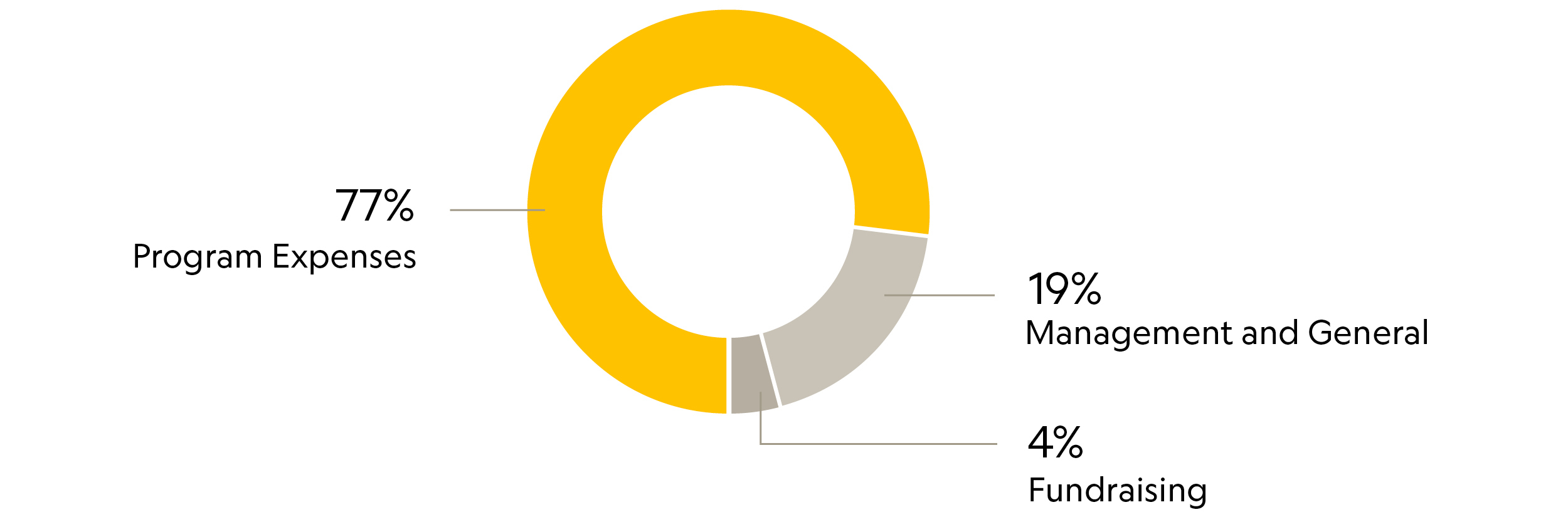
100 percent of donor contributions go to support Explorers and our mission work.
The Power of Philanthropy
2024 by the Numbers
Thank YoU
Thank you for supporting the National Geographic Society.
Contributions from donors like you help us to expand our bold vision and fund purpose-driven and passionate Explorers around the globe. As we embark on our next era of exploration, it is critically important to have dedicated supporters like you helping us continue making bold moves into the future.
Photo credits from top of page: Brian Skerry, Mark Thiessen, Jean Case, Visualizations by REDVERTEX based on designs by Hickock Cole Architects (3), Sirachai Shin Arunrugstichai, Jeff Kerby, Jason Gulley, Manu San Félix, Rob Taylor, Joel Sartore, Maddie McGarvey, Luján Agusti, Jean-Philip Lessard, Vandilson Almeida, Thomas Peschak (2), Manu San Félix, Jaime Rojo, Ashley Zafaranlou, Sofia Lopez Mañan, Katie Orlinsky, Nick St. Oegger, Olivier Nsengimana, Luján Agusti, Rainer von Brandis, Joel Sartore, Sam Sheline, Mark Thiessen, Robbie Shone, Jun Michael Park, Khansa Bouaziz, Tailyr Irvine, Thomas Peschak, Davide Monteleone, Esther Ruth Mbabaz, Mark Thiessen, Terry Virts, Brittany Mumma, Russell Laman, Terry Virts, Iñigo San Félix, Manu San Félix, Rainer von Brandis, Maddie McGarvey, Jon Brack, Tommy Trenchard, Brent Kunkle, Guy Stevens/Manta Trust, Laurent Ballesta, Mark Thiessen, Joy Asico-Smith, Jason DeWitt, Mark Thiessen, Russell Laman, Mark Thiessen, Karabo Moilwa